The risk with Arabic décor in a modern interior is not that it clashes. It is that it tips into theme — a room that reads as a concept rather than a home. The line between the two is mostly about quantity and restraint, not about the pieces themselves.
What follows is how to use it so the room stays contemporary and the heritage still shows.
One strong element, then stop
The single most effective rule: choose one piece to carry the character of the room, and let everything around it be quiet.
A calligraphy panel above a plain sofa works. A calligraphy panel above a patterned sofa, beside a fretwork screen, on a patterned rug, does not — not because any one of them is wrong, but because they are all competing to be the thing you look at.
Contemporary interiors are built on contrast between plain expanses and concentrated detail. Traditional Arabic interiors are too, which is why the two combine more easily than people expect.
Motif is not the same as pattern
A motif is a shape used once with intent. A pattern is that shape repeated until it becomes texture.
Both belong, but they behave differently. A single arabesque form on a box lid reads as a considered detail. The same form tiled across a wall becomes a surface, and the room now has a theme rather than an accent.
In a modern home, lean toward motif. Save true pattern for one contained place — a screen, a panel, a single cushion — where it has a boundary.
Let the material do the modernising
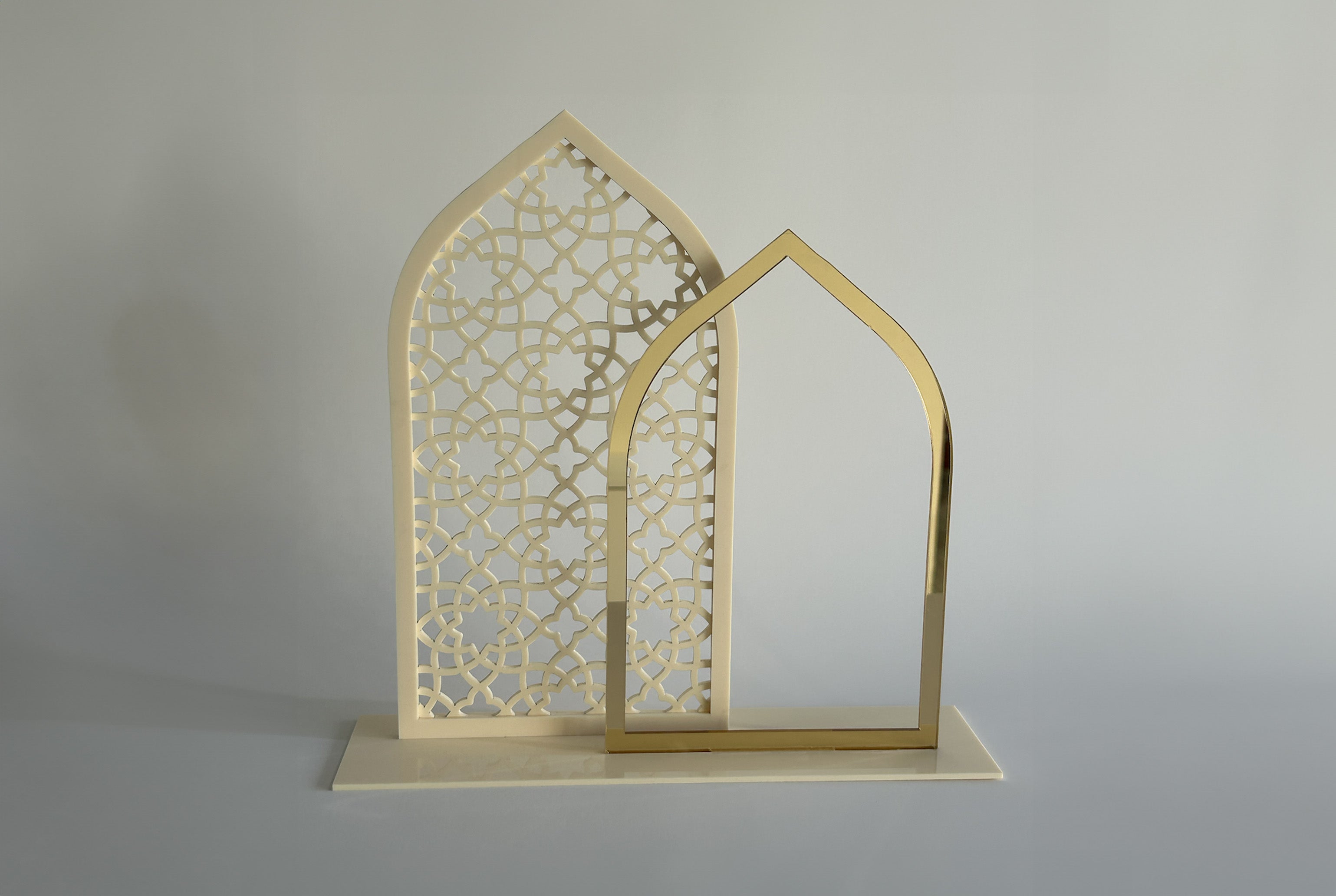
The quickest way to keep heritage forms contemporary is to change what they are made of. A traditional lattice cut in dark acrylic reads differently from the same lattice carved in wood: the geometry is historic, the material is not, and the tension between them is what makes it feel current.
Clear and black acrylic are particularly useful because they add edge without visual weight. In a small apartment, a transparent piece occupies space optically without filling it.
Colour: restraint beats richness
Jewel tones and heavy gold are the shorthand for Arabic interiors, and they are the fastest route to theme.
A more modern palette keeps the base neutral — ivory, sand, off-white, charcoal — and uses one metallic or one saturated colour as punctuation. Gold used sparingly reads as luxury; gold used broadly reads as pastiche.
This is also more practical in Dubai apartments, where light is strong and warm neutrals hold up better than dark saturated walls.
Calligraphy needs negative space
Arabic script is a line with movement and direction. Crowded, it becomes decoration; given space, it stays legible as writing, which is the whole point.
Hang calligraphy where there is empty wall around it. Do not centre it in a gallery wall of other frames — it will be read as one more rectangle. Give it its own plane.
Function keeps it honest
The pieces that never tip into theme are the ones that do a job. A tray that carries coffee, a box that holds dates, a mirror you check on your way out — these are furnishings that happen to be beautiful, and no one reads a used object as a costume.
Purely decorative objects carry the theme risk. That is not an argument against them; it is an argument for fewer of them.
A working ratio
If it helps to have a number: in any one room, aim for roughly one strongly ornamental piece, two or three quietly patterned or textured items, and everything else plain. That proportion keeps the heritage legible without letting it take over.
Scale it down further in small rooms. In a compact Dubai apartment, one strong piece per room is usually the whole budget of attention the space has.
The short version
- One strong piece per room, with space around it
- Motif over repeated pattern; contain pattern where you use it
- Heritage geometry, modern material
- Neutral base, metallic or colour as punctuation
- Favour pieces that do a job
Our pieces are handcrafted to order in Dubai, in sizes matched to the wall or surface they are going on. If you are unsure whether something will read as accent or as theme in your particular room, send a photo — that is a judgement that is much easier to make with the room in front of you.
Related reading: Arabic Calligraphy Wall Art: Ideas for Every Room.