Majlis decoration starts from how people sit: seating around the edges facing inward, a clear centre, low warm light in several places, serving pieces that live in the room, and one strong piece of calligraphy on the wall the seats face, with plain space around it. For the tables themselves, see our majlis table décor page. A majlis is not a style of decoration. The word means a place of sitting, and everything about the room follows from that: it exists so that people can sit together, at length, and talk.
Once you understand it as a room organised around conversation rather than around a focal wall or a television, the styling decisions stop being aesthetic preferences and start being practical ones.
Seating faces inward, and nobody sits at the head
The defining feature is perimeter seating facing into the room. It is an old arrangement and a deliberate one: everyone can see everyone, no one is positioned above anyone else, and conversation belongs to the group rather than radiating from one seat.
In a modern living room the television usually breaks this, because every chair ends up aimed at a wall. You do not have to remove it — but turning one or two seats to face the sofa rather than the screen fundamentally changes what the room invites people to do.
Keep the centre clear. The empty middle is not wasted; it is what makes the circle legible.
Low, and generous
Traditional majlis seating sits low, often close to the floor, with substantial cushions. Low seating slows a room down — people settle rather than perch, and they stay longer.
If floor seating is impractical, the principle still translates: choose deeper seats over upright ones, and keep side tables low enough to reach from a seated position without standing. A coffee table that is too tall to reach comfortably quietly ends the hospitality it was bought to serve.
 «الضيف عزيز» — Acrylic Serving Tray · Naskh
From Dhs. 115
«الضيف عزيز» — Acrylic Serving Tray · Naskh
From Dhs. 115
 Censers – Mabkhara, set of 3 or single
From Dhs. 85
Censers – Mabkhara, set of 3 or single
From Dhs. 85
 Masjid Lantern Set
Dhs. 115
Masjid Lantern Set
Dhs. 115
Light low, warm, and in several places
Overhead lighting is the enemy of a long conversation. It is unflattering, it is uniform, and it signals a room you pass through.
A majlis wants several warm sources at or below eye level. Lanterns and pierced panels do particularly well because they break the light into pattern — the walls acquire texture that shifts as the evening goes on. Dimmable lamps do the same job less romantically and more conveniently.
Serving is designed in, not fetched
In Gulf hospitality the gap between a guest sitting down and being offered something should be close to nothing. That is a spatial requirement as much as a social one: what you serve with has to live in the room.
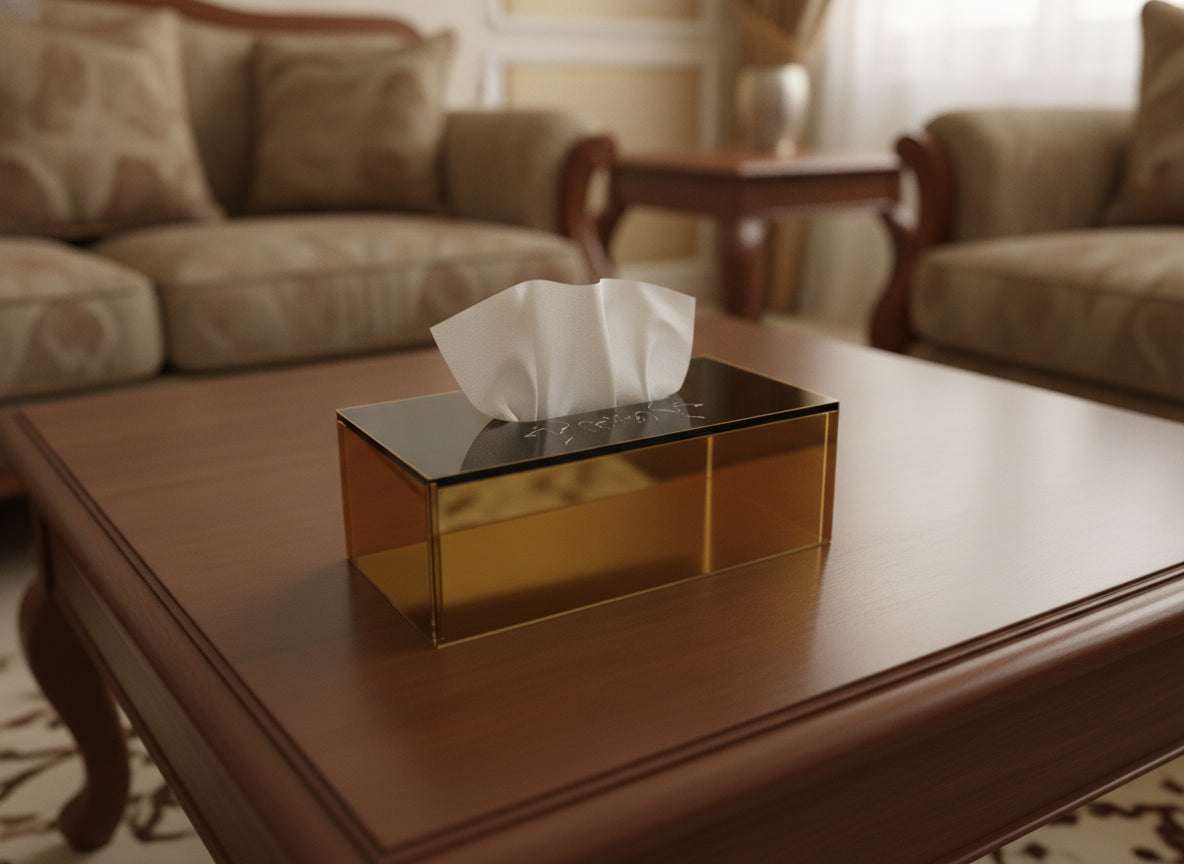
A tray already laid, a dates box already on the low table, a jar already filled. The point is that the host does not disappear. A guest left alone while someone assembles a tray in the kitchen has been given the wrong signal in the first two minutes.
This is why serving pieces in a majlis are decorative — they are out permanently, so they may as well be worth looking at.
Scent, used as punctuation
Bakhoor is part of the room's grammar. A mabkhara passed around after a meal, or lit shortly before guests arrive, marks a moment rather than perfuming a space continuously.
Restraint matters. Scent that is always present stops being noticed; scent introduced at a point in the evening is remembered.
Pattern, and where to stop
Arabesque and geometric pattern belong here, but a majlis is not improved by pattern everywhere. The traditional arrangement is disciplined: strong ornament in defined places — a panel, a screen, a border — against plain expanses of wall and textile.
Calligraphy follows the same rule. One piece leading, with quiet around it, reads as intentional. Several competing pieces read as a showroom, and each one weakens the others.
Calligraphy for a majlis
The majlis is where calligraphy is most at home in the Gulf, and the room's own rules choose the piece. Hang it on the wall the seating faces most, with its centre about 150 cm from the floor, so seated guests look slightly up to it. A majlis wall usually wants a large piece: A1 or larger above a long sofa, A0 or 90×120 cm for a whole wall. Thuluth is the classic majlis script, legible from across the room, and a verse such as «الله لا إله إلا هو الحي القيوم» or «بسم الله الرحمن الرحيم» is the traditional choice, hung where it is honoured. Paints start at AED 60; Thuluth master pieces and signed originals are the two places to look first. For the numbers, read how to choose the size and which verses suit which room.
Bringing it into an apartment
Most Dubai homes do not have a dedicated majlis, and they do not need one to use the idea. The transferable parts are:
- One seat turned to face the conversation instead of the screen
- Two or three warm, low light sources instead of one overhead
- Serving pieces that live in the room rather than the kitchen
- A clear centre
- One strong ornamental piece, with space around it
None of that requires a larger home. It requires deciding what the room is for.
Our trays, boxes, lanterns and panels are made to order in our UAE workshop, sized to the space they are going into. If you are setting up a majlis corner and want help judging proportions, send us the room dimensions — scale is the thing that most often goes wrong, and it is the easiest to get right in advance.
Related reading: Mabkhara 101: A Guide to Arabian Incense Burners.
Want to see the words before you order? Set them yourself in Mashq Studio, free, in six scripts.
Part of our room-by-room guide: Arabic Calligraphy Wall Art: Ideas for Every Room.