Most gifts are chosen from a category: a tray, a frame, a box. A personalised piece is chosen from a person. That is the whole difference, and it is why name pieces get kept when other gifts quietly move on.
It is also why they go wrong more often. A generic object cannot be misspelled.
Get the spelling from them, not from English
This is the one that matters most. Arabic spelling cannot be reliably derived from a Latin transliteration — several spellings are usually defensible and only one is theirs.
Mohammed, Muhammad, Mohamad and Mohamed are all the same name in English and can map to different renderings in Arabic. Names of Persian, Turkish or South Asian origin vary more still.
So: ask for the name written in Arabic script. A photo of it handwritten, or a message with the Arabic text, removes all ambiguity. If it is a surprise and you cannot ask, ask a family member — not a translation tool.
Decide which name
Less obvious, and a frequent regret. Options:
- One given name — personal, works for an individual's own space
- Two given names together — the standard wedding and couple piece
- The family name — best for a shared home, entrances and majlis
- Name with «آل» or «بيت» — the family of, the house of — reads as a household rather than a person
For weddings, do not assume a name change. Ask, or use both given names.
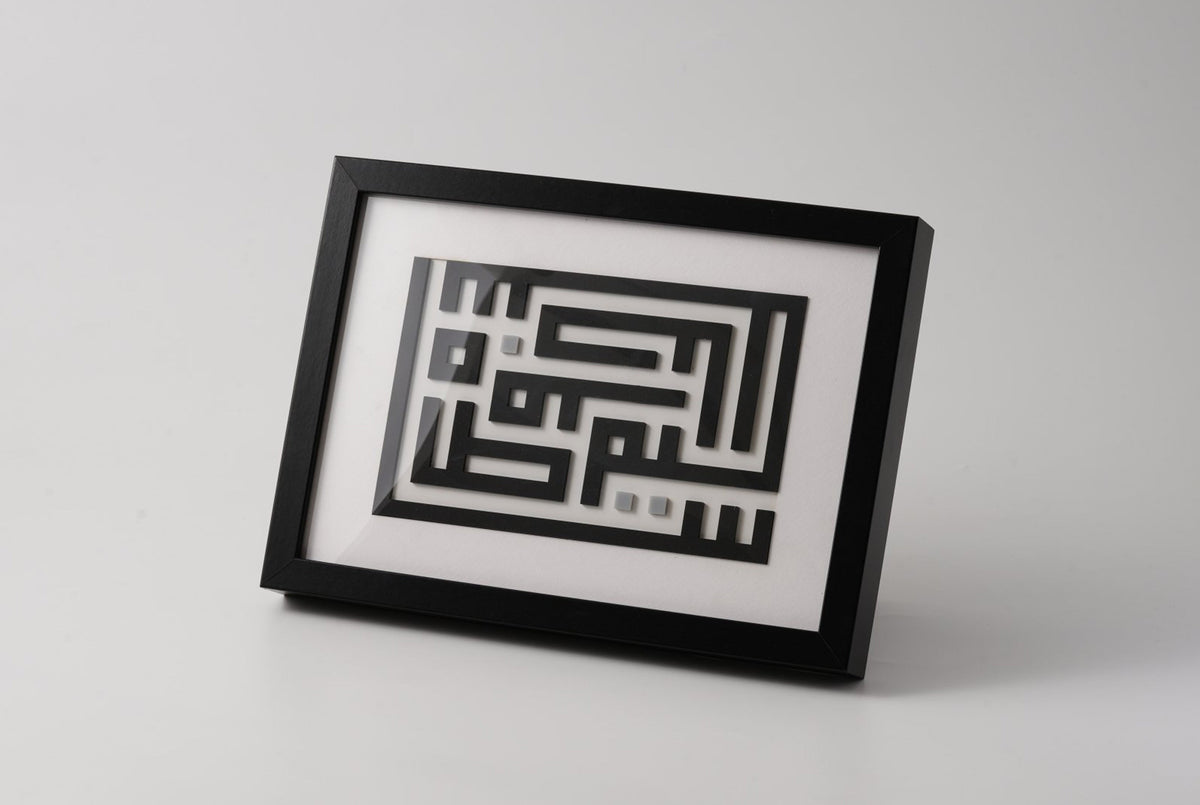
 Personalised Kufic Name Frame
Dhs. 265
Personalised Kufic Name Frame
Dhs. 265
 Wissam Arabic Calligraphy Letter Black
Dhs. 195
Wissam Arabic Calligraphy Letter Black
Dhs. 195
 Wissam Arabic Letter Glass Jar
Dhs. 150
Wissam Arabic Letter Glass Jar
Dhs. 150
Script changes the whole character
The same name in two scripts produces two very different objects.
- Square Kufic compresses the name into a geometric block. It reads as design — contemporary, graphic, at home in a modern apartment. It also holds up small.
- Diwani flows and interlocks, dense and ornamental. It reads as heritage and luxury, and suits short names especially well.
- Thuluth is monumental and sweeping. Beautiful, but it needs scale — a Thuluth name in a small frame loses what makes it Thuluth.
- Ruq'ah is everyday handwriting. Informal and personal rather than ceremonial.
If you are unsure: square Kufic for a modern home, Diwani for something that should feel like an heirloom.
Short names and long names behave differently
A short name has room to be elaborate — Diwani flourishes, generous spacing, ornamental marks. A long name or a full family name needs discipline, or it becomes a dense block with no air in it.
This is worth raising before you choose a frame size. The proportion that suits «نور» is not the proportion that suits a three-part family name.
Where it will hang
Calligraphy needs negative space to read as writing rather than as pattern. A name piece belongs on its own plane — an entrance wall, above a console, a clear stretch beside a doorway.
Do not slot it into a gallery wall among photographs. Surrounded by other frames it becomes one more rectangle, and the thing that made it personal disappears.
Timing
Personalised work has an extra step before production starts: confirming the spelling and approving the layout. Our production takes 5–7 working days after that, plus delivery.
Two to three weeks ahead is comfortable for a wedding or Eid. Three days is not — and personalisation is precisely the thing that cannot be rushed, because the correction cycle is where the time goes.
Why they last
A name piece cannot be duplicated by another guest, does not date, does not depend on a colour scheme, and answers the question every new home implicitly asks — whose home is this?
That is an unusual amount of work for one object, and it explains why these are the pieces customers photograph years later.
Is the name written by hand?
On a name frame, no. Your name is set in a classical script, Diwani, Thuluth or Nastaliq, from a real calligraphic typeface, and the spelling is checked with you first. It is then printed on cotton canvas and framed by hand in our UAE workshop: AED 185 framed in A3, or AED 75 rolled. Because the name is set rather than drawn, you see its exact spelling and shape before anything is made.
Calligraphy written in ink by a calligrapher's own hand is an original. Ours are signed originals by three living calligraphers, from AED 550.
Before you order, settle these
- The name in Arabic script, from them or their family
- Which name — given, both, or family
- Script: square Kufic, Diwani, Thuluth or Ruq'ah
- Where it will hang, and how much clear wall it has
- Your deadline, minus two weeks
Every personalised piece is made to order in our UAE workshop, and we send you the layout to approve before anything is printed or cut. If you have the name but not the script, send us the Arabic and a photo of the wall — that is usually enough for us to recommend one.
More on Arabic names
- 48 Arabic names and their meanings, each written in calligraphy
- Two names on one line: wedding gifts for newlyweds
- Customised gifts by occasion and budget
Quick answers
How do I get the spelling of a name right? Ask for the name written in Arabic script, from the person or a family member, rather than working from an English transliteration or a translation tool.
How long does a name piece take? The spelling and layout are confirmed with you first, then it takes 5–7 working days to make, plus delivery; two to three weeks ahead is comfortable for a wedding or Eid.
Which script suits a name? Square Kufic for a modern home, Diwani for a piece that should feel like an heirloom, and Thuluth only when there is room for it to be large.
Keep reading: 48 Arabic Names and Their Meanings, in Calligraphy · Bespoke Arabic Calligraphy in the UAE: How to Commission a Piece. Want to see the name before you order? Set it yourself in Mashq Studio, free, in six scripts.
About this guide: written by MASHQ, which makes Arabic calligraphy pieces to order in its UAE workshop and builds Mashq Studio (1click2open LLC, Sharjah). Prices were checked against the shop in October 2026. The originals we sell are written by hand and signed by the calligraphers on our artists page — Anwar Alhulwani, Ahmed Alhawary and Rasha Kasim — and Affanah Zohir's work is sold as fine-art prints; everything else is our own studio work, set in classical scripts.