Mashallah, «ما شاء الله», means "what God has willed": whatever good you are looking at came about because God willed it, not by anyone's own power. The words come from the Qur'an, al-Kahf 18:39, and people say them when they admire something, a baby, a home, a success, often adding Tabarakallah, "blessed is God", as a prayer for blessing.
The three words, one by one
- «ما» (ma): "what", pointing at the thing in front of you. Commentators read the phrase in two ways: "this is what God willed", or "what God wills comes to be".
- «شاء» (sha'a): "willed", a past-tense verb from the root of «مشيئة», will or intent.
- «الله» (Allah): God, the one whose will it was.
Before praising a thing, the speaker names where it came from.
Mashallah or masha Allah: which spelling is right?
Both, because both are English spellings of the same Arabic. In Arabic there is only one way to write it: three separate words, «ما» then «شاء» then «الله», as they stand in the Qur'an. "Ma sha' Allah" keeps the three words visible; "mashallah" runs them together the way the phrase is spoken. In English, use the one your reader recognises; in Arabic, write the three words apart. A calligrapher may stack them on a wall, but all three stay whole.
 «ما شاء الله» — Calligraphy Paint · Diwani
From Dhs. 60
«ما شاء الله» — Calligraphy Paint · Diwani
From Dhs. 60
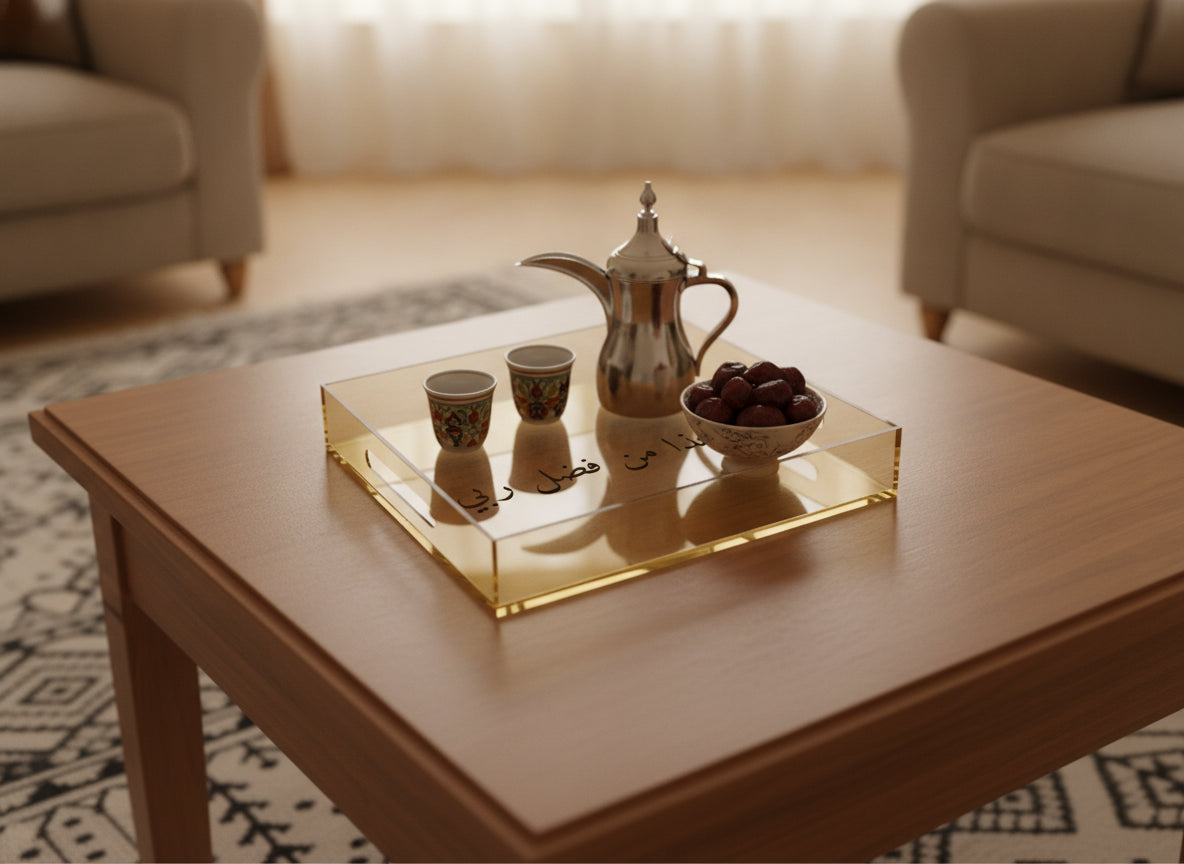
 «هذا من فضل ربي» — Acrylic Serving Tray · Naskh
From Dhs. 115
«هذا من فضل ربي» — Acrylic Serving Tray · Naskh
From Dhs. 115
 «الحمد لله» — Acrylic Serving Tray · Kufi
From Dhs. 115
«الحمد لله» — Acrylic Serving Tray · Kufi
From Dhs. 115
Where it comes from: the man with two gardens
The phrase is in Surat al-Kahf, in the parable of two men. One was given two gardens of vines ringed with palms. He walked into his garden pleased with himself, sure it would never perish, and his companion told him:
«ولولا إذ دخلت جنتك قلت ما شاء الله لا قوة إلا بالله» (al-Kahf 18:39). Meaning: "If only, when you entered your garden, you had said: what God wills; there is no power except with God."
The fruit was later destroyed, and the line stayed as the lesson: whatever you own, say whose it is. That is why it is written over doors.
Tabarakallah, barakallah, and the longer forms
- «تبارك الله» (tabarakallah): "blessed is God", or "exalted is God and great His goodness". The word is Qur'anic: «فتبارك الله أحسن الخالقين» (al-Mu'minun 23:14), meaning "so blessed is God, the best of creators". «ما شاء الله تبارك الله» puts the two together: this is God's doing, and God is blessed for it.
- «بارك الله فيه» (barakallahu fihi): "may God bless him (or it)", a prayer for the person you are admiring. It follows a hadith in Sunan Ibn Majah 3509: when a man admired another's appearance, the Prophet ﷺ said «إذا رأى أحدكم من أخيه ما يعجبه فليدع له بالبركة», meaning "if one of you sees in his brother something he likes, let him pray for blessing for him."
- «ما شاء الله لا قوة إلا بالله»: the phrase as the verse has it, "what God wills; there is no power except with God". Many people prefer the full form on a wall because it reads exactly as in the Qur'an.
Mashallah or inshallah?
Mashallah is for what has already happened and is in front of you; inshallah, «إن شاء الله», "if God wills", is for what has not happened yet. The second also has its root in al-Kahf: «ولا تقولن لشيء إني فاعل ذلك غدا» «إلا أن يشاء الله» (al-Kahf 18:23–24), meaning "and never say of anything, 'I will do that tomorrow', without 'if God wills'". So to new parents you say mashallah; to parents expecting a baby, inshallah.
When people say mashallah
- On seeing a newborn: the first word at a baby visit.
- On entering a new home, or seeing a new car or shop.
- On hearing good news: a graduation, a new job, a recovery.
- About one's own blessings too, as the man in the parable was told to.
This is everyday custom, described here as custom, not as a ruling.
Mashallah on the wall: where it hangs and in which script
It hangs most often by the front door, where it is the first thing a guest reads, and in the majlis or a nursery. Hang it somewhere honoured, at eye level or above; our guide to Qur'anic verses for the home covers the courtesies.
- «ما شاء الله» in Diwani, as a calligraphy paint: from AED 60 as a rolled A3 canvas, AED 150 framed at A3, AED 245 framed at A2. Diwani's looping letters suit a short phrase.
- «هذا من فضل ربي» on a Naskh serving tray: AED 115 clear, AED 165 gold-tinted. A blessing line often given with a new baby.
- «الحمد لله» on a Kufi serving tray: AED 115 or AED 165.
More phrases are in Islamic calligraphy, and gifts for a new baby in newborn gifts. If you want the longer form, «ما شاء الله تبارك الله» or «ما شاء الله لا قوة إلا بالله», write it in Mashq Studio, free, in the script you choose, or start from the newborn page, and order it as a paint. We check the text with you letter by letter before printing.
What to write on a newborn card
A short line of your own is enough, for example «ما شاء الله تبارك الله، ألف مبروك المولود», "mashallah tabarakallah, a thousand congratulations on the baby". Write it under "Order instructions" in your cart, or send it on WhatsApp; it travels on a card with no price. Gift wrapping is AED 20 per order.
Quick answers
What does mashallah tabarakallah mean? "What God has willed; blessed is God." It credits a good thing to God and asks for blessing on it.
Where is mashallah in the Qur'an? In Surat al-Kahf, 18:39, in the words «ما شاء الله لا قوة إلا بالله».
How much is a mashallah calligraphy paint? The Diwani «ما شاء الله» paint is from AED 60 as a rolled A3 canvas, and AED 150 framed at A3.
Making and delivery
Paints and trays are made to order in our UAE workshop in 5–7 working days. UAE delivery is AED 50 per order when wall art is in it and AED 25 for décor alone, and you can change or cancel free within 12 hours of ordering.
Keep reading: 43 Arabic Phrases for Wall Art, With Their Meanings · The Meaning Behind Popular Arabic Calligraphy Phrases · Diwani phrases in Mashq Studio.
About this guide: written by MASHQ, which makes Arabic calligraphy pieces to order in its UAE workshop (1click2open LLC, Sharjah). Verses are quoted from the Qur'an with their sura and verse, and the hadith from Sunan Ibn Majah with its number. Prices were checked against the shop in October 2026.