Choosing the line is the whole decision. A wall in a UAE home usually carries one phrase for years, so it should be one that reads well from across the room, means something to the people who live there, and comes from somewhere you can name. Here are 43 Arabic and Persian phrases we write and make — each with its meaning, its source where one can honestly be given, and where it hangs best. Every one is available as a calligraphy paint from AED 60, or engraved on a tray or tissue box; and any name or phrase not on this list can be written in Mashq Studio.
Quranic verses for the home
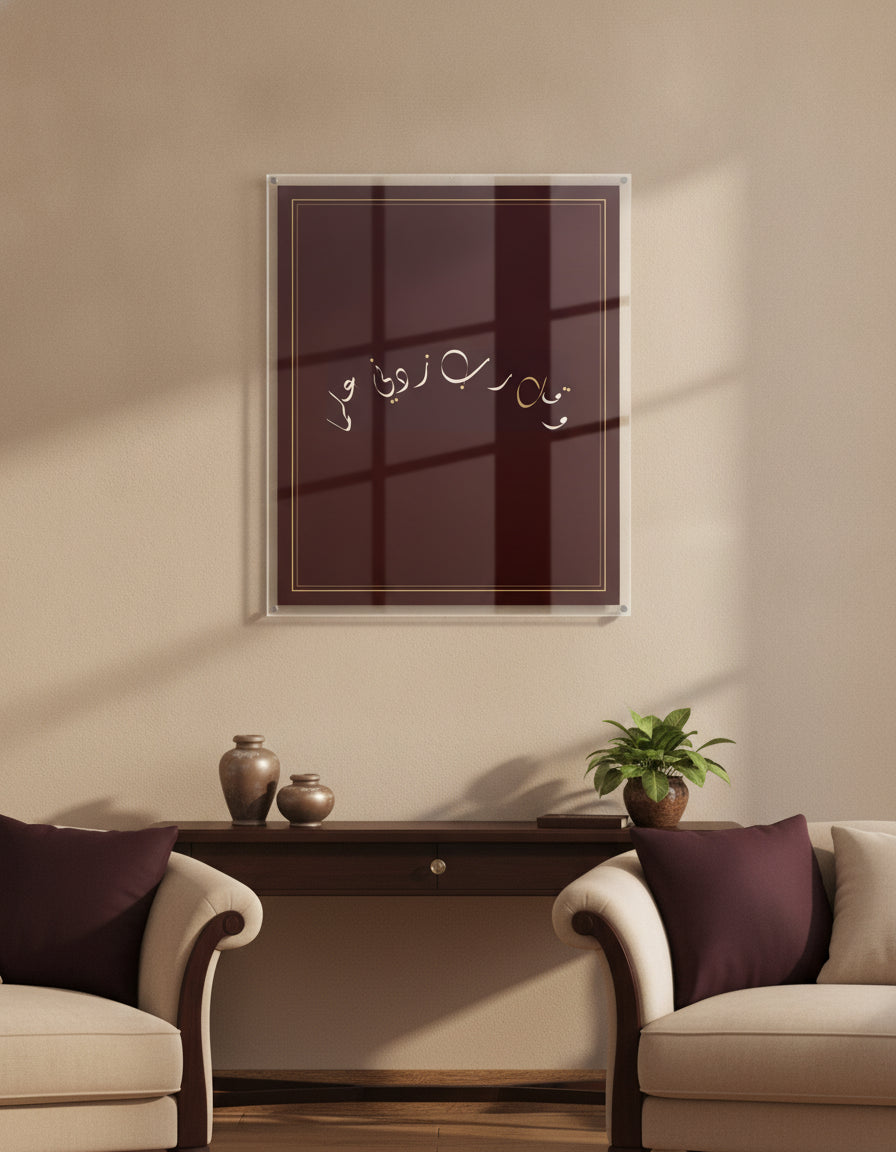
«وقل رب زدني علما» — And say: my Lord, increase me in knowledge
Quran, Sūrat Ṭā-Hā 20:114. The one prayer the Prophet was commanded to keep asking. See the paint →
«إن مع العسر يسرا» — With hardship comes ease
Quran, Sūrat Ash-Sharḥ 94:6. Not after hardship — with it, in the same breath; the verse is repeated twice in the sura, and scholars read the repetition as a promise that one hardship never outweighs two eases. See the paint →
«هذا من فضل ربي» — This is by the grace of my Lord
Quran, Sūrat An-Naml 27:40. The line for a new business, a new home and every good thing one is careful not to claim alone. See the piece →
«نور على نور» — Light upon light
Quran, Sūrat An-Nūr 24:35. Three words from the Verse of Light, the passage most often written in mosques. See the piece →
Arabic proverbs and sayings
«خير جليس في الزمان كتاب» — The best companion of all time is a book
al-Mutanabbi. The second half of a line whose first half praises the saddle of a swift horse; the tenth-century poet set the two side by side, and only the book survived into every library in the Arab world. See the paint →
«العلم نور» — Knowledge is light.
Two words, and the shortest line in this collection; a proverb heard in every Arab classroom, usually completed by “and ignorance is darkness.” Its brevity is the point on a wall: it reads from across a room, which is why it is chosen for entrances, libraries and the first day of school. See the paint →
«القناعة كنز لا يفنى» — Contentment is a treasure that never runs out.
An Arabic proverb, often quoted as a hadith and not securely one; we label it a proverb because that is what we can stand behind. See the paint →
«من جدّ وجد» — Who strives, finds.
Three words that rhyme in Arabic and are usually completed by “and who sows, reaps.” It is the proverb of exam season and of the first office: short enough to read over a desk, old enough that nobody argues with it. See the paint →
«الجار قبل الدار» — The neighbour before the house.
The proverb every Gulf family says while house-hunting: choose the neighbour first, then the walls. See the paint →
«في التأني السلامة» — In taking your time there is safety.
The first half of a proverb whose second half warns that haste brings regret. See the paint →
«الصبر مفتاح الفرج» — Patience is the key to relief.
The most-given Arabic proverb for a hard season: illness, a long wait, a business that has not turned yet. See the paint →
«با دوستان مروت با دشمنان مدارا» — Generosity with friends, forbearance with enemies
Saadi. The second half of the couplet that promises the comfort of both worlds in two words — these are the two. See the paint →
«توانا بود هر که دانا بود» — Able is the one who is wise
Ferdowsi, Shahnameh. From the opening lines of the Persian national epic: with knowledge, the line continues, an old heart grows young. See the paint →
Persian poetry — Saadi, Rumi, Hafez, Ferdowsi
«بنیآدم اعضای یکدیگرند» — The children of Adam are limbs of one another
Saadi, Golestan. The opening of the couplet inscribed at the entrance to the United Nations: created from one essence, when one limb is in pain the others cannot rest. See the paint →
«آسایش دو گیتی تفسیر این دو حرف است» — The comfort of both worlds is the meaning of these two words
Saadi. The first half of a couplet whose second half names the two words: generosity with friends, forbearance with enemies. See the paint →
«باران که در لطافت طبعش خلاف نیست» — The rain, whose gentleness none disputes
Saadi. The line continues: in the garden it raises tulips, on the salt flat only weeds. See the paint →
«بشنو از نی چون حکایت میکند» — Listen to the reed, how it tells its tale
Rumi, Masnavi, line 1. The first line of the Masnavi, and the most famous opening in Persian literature: the reed flute laments being cut from the reed bed, and the whole poem's argument about longing is in that first breath. See the paint →
«هر چه هست از قامت ناساز بیاندام ماست» — Whatever is amiss is from our own ill-fitting stature
Hafez. The most self-aware line in the collection: the robe of honour is not short, the poet says; we are misshapen. See the paint →
«از محبت خارها گل میشود» — Through love, thorns become flowers
attributed to Rumi. Popularly given to Rumi and printed that way everywhere; it is not securely placed in the Masnavi or the Divan, so we say attributed and leave it there. See the paint →
«ز گهواره تا گور دانش بجوی» — Seek knowledge from the cradle to the grave.
A Persian rendering of a saying that circulates in Arabic too, quoted as a proverb far more often than it is traced; no dīwān reference is offered because none can be given honestly. See the paint →
For the majlis and the front door
«قهوتي سادة… ومزاجي كذلك» — My coffee's black, and so is my mood.
Dry Gulf humour on 5 mm acrylic. See the piece →
«الحمد لله» — Praise be to God.
The two words a table starts and ends with. See the piece →
«بيتنا جنتنا» — Our home is our paradise.
The housewarming line. See the piece →
«دار السعادة» — The house of happiness.
A wish written in the present tense. See the piece →
«صباح الخير» — Good morning.
The simplest thing a tray can say, and the one that gets used every single day. See the piece →
«سلام» — Peace.
One word, and the whole greeting. See the piece →
«حياكم الله» — God greet you; welcome.
The Gulf welcome, said at the door and repeated at the coffee. See the piece →
«جمعة مباركة» — Blessed Friday.
The Friday-lunch tray: it comes out once a week, for the family meal after prayer, and it is the gift for the parents who host that lunch.. See the piece →
«تفضلوا» — Please, be served.
The word a host says while setting the tray down, now written on the tray itself. See the piece →
«أهلاً وسهلاً» — Welcome.
The welcome every Arabic speaker knows and every visitor learns first. See the piece →
«الضيف عزيز» — The guest is dear.
The Gulf's rule of hospitality in two words. See the piece →
«المحبة» — Affection.
One word for the thing a home is made of. See the piece →
Coffee and tea — the lines for the kitchen
«ما قبل القهوة لا يُحتسب» — Whatever happened before coffee doesn't count.
The line for the household where nobody speaks before the first cup. See the piece →
«الشاي حلّ لكل شيء» — Tea is the answer to everything.
A karak kitchen's motto. See the piece →
«كوب واحد لا يكفي» — One cup is never enough.
The honest tray. See the piece →
«صباح القهوة» — A coffee morning.
The greeting half the Gulf sends before “good morning.” This is the tray that carries the first two cups to the balcony, and the one most often given to a new home together with the matching tissue box.. See the piece →
«الحبّ من أول رشفة» — Love at first sip.
The wedding-shower tray and the anniversary tray: two cups, one phrase, the joke that stays true. See the piece →
«شاي كرك والدنيا بخير» — Karak tea and all is right with the world.
The UAE's national comfort in one line. See the piece →
«لا تكلّمني قبل القهوة» — Don't talk to me before coffee.
A warning, kindly meant. See the piece →
«قهوة عربية وقلب طيّب» — Arabic coffee and a kind heart.
The two things a majlis offers first. See the piece →
«فنجان قهوة وسالفة» — A cup of coffee and a good chat.
Sālfa is the Gulf word for the story you sit down for. See the piece →
«قهوة الصباح» — Morning coffee.
The ritual named plainly. See the piece →
«فنجان محبة» — A cup of affection.
What a cup of Arabic coffee actually is, in two words. See the piece →
How to choose
For a living room: a Quranic verse or a proverb about the home — «الجار قبل الدار», «بيتنا جنتنا», «إن مع العسر يسرا». For a study or a child's room: anything about knowledge — «وقل رب زدني علما», «العلم نور», «توانا بود هر که دانا بود». For a gift: a name, always; or «الحمد لله» for a new home and «فنجان محبة» for a mother. For a wedding: «از محبت خارها گل میشود» or the couple's two names on one line.
All of it is printed or cut to order in our UAE workshop in 5–7 working days. Delivery anywhere in the UAE is a flat AED 50 per order for wall art and AED 25 for décor. See the wall art →
Related reading: Qur'anic Verses for the Home: Which to Hang, Where, and How · 48 Arabic Names and Their Meanings, in Calligraphy.