Most rooms that feel tired do not need redecorating. They need editing, and then two or three deliberate additions. Repainting is expensive and disruptive; changing what sits on the surfaces takes an afternoon and does most of the work.
Here are five changes, roughly in order of how much they shift a room per dirham spent.
1. Change the light before you change anything else
A single overhead fitting flattens a room. It casts everything in the same tone, puts shadows under people's eyes, and makes a space feel like a corridor you are passing through.
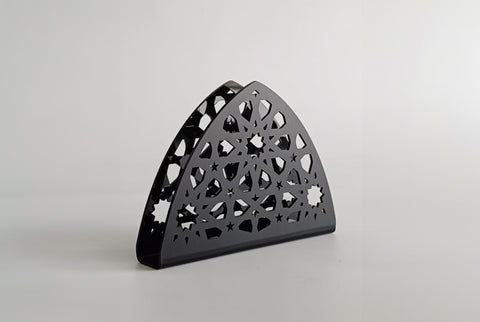
Adding two or three light sources at seated height — lamps, lanterns, candles — changes the room more than new furniture would. Fretwork pieces are particularly effective, because they do not just emit light, they pattern it. A pierced lantern or mashrabiya panel throws shapes onto the wall, and that movement is what makes a room feel alive after dark.
If you do one thing from this list, do this one.
2. Take everything off, then put less back
Before buying anything, clear a surface completely. Console, coffee table, shelf — take it all off and look at the empty plane.
Then return items one at a time, stopping when the arrangement still reads as calm. Most people stop two or three objects later than they should. Aim to leave about a third of the surface clear; it will look considered rather than sparse, and there will still be somewhere to put a cup down.
This step costs nothing and it is the reason most styling advice fails — people add to a crowded surface instead of clearing it first.
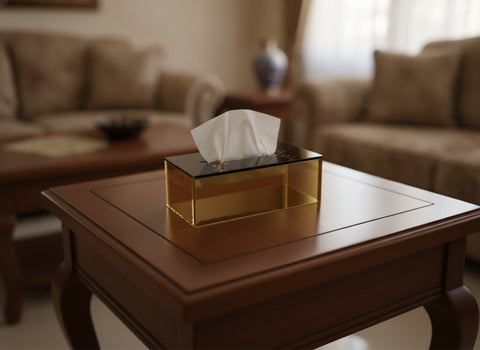
3. Introduce one material the room does not have
Rooms go flat when everything shares a texture. A living room of fabric sofa, fabric curtains and a fabric rug has nothing for the eye to catch on.
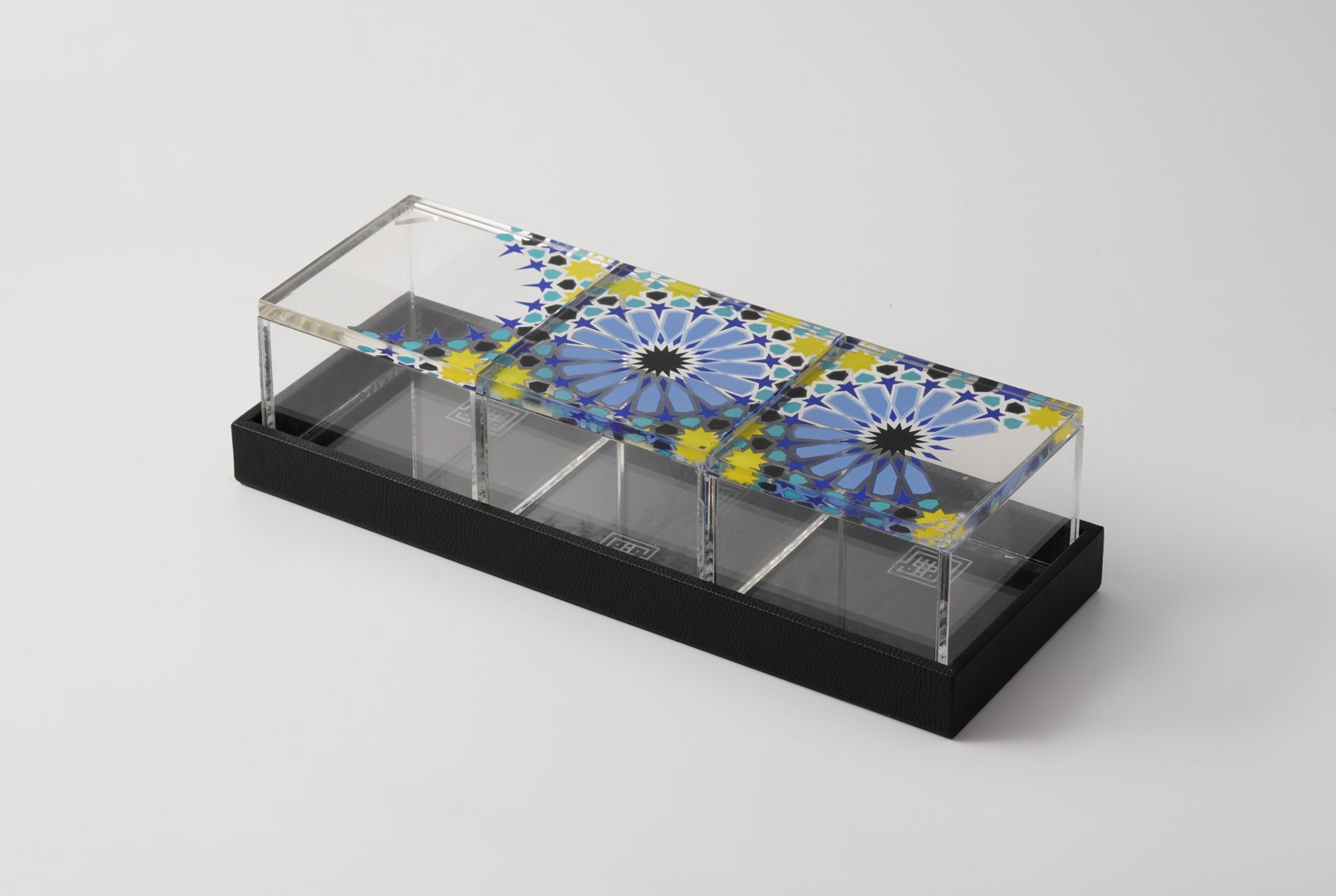
Add one contrasting material and the whole space sharpens: something transparent, something metallic, something matt black. Clear acrylic is useful here precisely because it adds edge and reflection without adding visual bulk — it reads as structure rather than as another object.
You are not redecorating. You are adding one note that is missing.
4. Give the room one piece worth looking at
There is a difference between a decorated room and a room with a focal point. A decorated room has many pleasant things. A room with a focal point has somewhere for your eye to land, and everything else supports it.
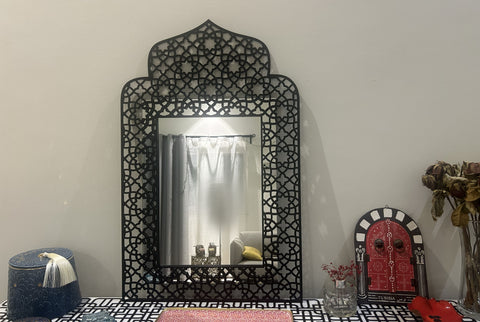
That piece should be the largest, the boldest, or the most meaningful — a calligraphy panel, a mirror, a single strong wall piece. Once it exists, the rest of the room can be quieter, which is usually cheaper as well as better.
The common mistake is buying several medium-impact pieces instead of one strong one. Three moderate objects compete; one strong object leads.
5. Group what is already scattered
Half of what makes a room look untidy is not clutter — it is clutter that has no border. Remote controls, candles, coasters and keys are all reasonable things to have out. Scattered across a surface they read as mess; gathered on a tray they read as an arrangement.
A tray is the cheapest styling tool there is, because it converts existing objects into a composition without buying anything new to put in it.
Do it in this order
- Clear the surfaces completely
- Fix the lighting
- Put back only what earns its place
- Add one missing material
- Group the strays on a tray
- Then, if the room still wants something, buy one strong piece — not three medium ones
Buying last rather than first is the part most people skip, and it is the part that saves money.
A note on seasons
Rooms feel stale when nothing in them ever changes. You do not need seasonal decor in any serious quantity — one or two swapped pieces are enough to reset a space. Keep the anchors constant and let one small element carry the time of year.
Our pieces are made to order in our UAE workshop, in sizes and finishes matched to the space they are going into. If you are working out what proportion suits a particular surface, send us the measurements — a piece that is slightly the wrong size is the one mistake styling advice cannot fix.
Keep reading: Small-Space Styling: Arabic Décor for Dubai Apartments · How to Style a Console or Coffee Table. Want to see the words before you order? Set them yourself in Mashq Studio, free, in six scripts.
Part of our room-by-room guide: Arabic Calligraphy Wall Art: Ideas for Every Room.