
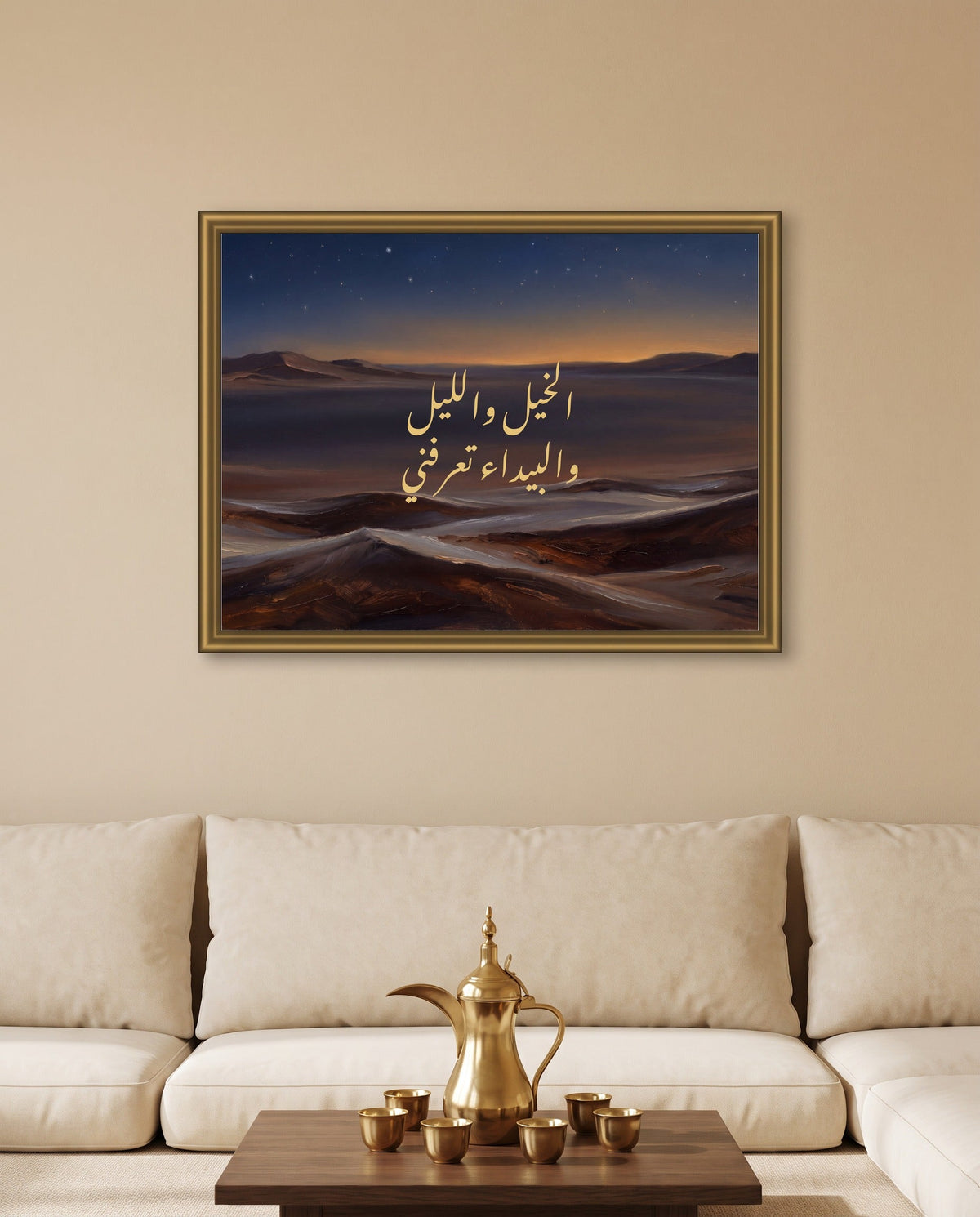
The most famous lines of Arabic poetry are short enough to learn by heart and old enough to have become proverbs: al-Mutanabbi on resolve, Ahmad Shawqi on teachers, Imru' al-Qais on a night that will not end. Here are 30 of them, grouped by theme, each with its meaning in plain words and its poet. Every line is also a calligraphy paint, made to order in the UAE, from AED 135 framed or AED 70 as a rolled canvas.
You can see them all, with the rest of the series, on our Arabic poetry paints page, sorted by script.
Lines on ambition and resolve
The Horse, the Night and the Desert
Al-Mutanabbi (915–965) says the horse, the night and the desert know him, then adds the sword, the spear, the paper and the pen: rider, fighter and writer in one line, and one of the most quoted boasts in Arabic. The Nastaliq paint.
Resolve Comes in the Measure of the Resolute
Al-Mutanabbi's ode for Sayf al-Dawla opens: resolve comes in the measure of the resolute, and noble deeds in the measure of the noble. What you achieve matches the size of your will; a gift for a new office or a graduation. The Nastaliq paint.
Do Not Settle for Less Than the Stars
Al-Mutanabbi again: if you venture after an honour, do not settle for less than the stars. If you take the risk, aim at the highest thing. The Nastaliq paint.
When Souls Are Great
When souls are great, al-Mutanabbi says, bodies grow tired serving their aims: the line people quote about ambition and its price. The Kufic paint.
Goals Are Not Reached by Wishing
Ahmad Shawqi (1868–1932): goals are not reached by wishing, but the world is won by striving. A plain lesson for a student's desk. The Thuluth paint.
Lines on patience and hope
The Winds Blow as the Ships Do Not Wish
Al-Mutanabbi: not everything a man wishes for, he attains; the winds blow as the ships do not wish. A proverb across the Arab world, said with a smile when plans change. The Nastaliq paint.
Let the Days Do as They Will
Imam al-Shafi'i (767–820), founder of one of the four schools of Islamic law: let the days do as they will, and be at peace when fate has ruled. A quiet line about accepting what you cannot change. The Nastaliq paint.
It Closed Fast, Then It Opened
A hardship tightened ring by ring, and just when it seemed closed for good, it opened. Widely attributed to Imam al-Shafi'i, though the attribution is not certain; a comfort for anyone in a hard season. The Nastaliq paint.
The Night Must Surely Clear
From The Will to Live by Abu al-Qasim al-Shabbi (1909–1934), the Tunisian poet who died at twenty-five: every dark stretch comes to an end. The Kufic paint.
How Narrow Life Would Be Without Hope
Al-Tughra'i (d. 1121): I comfort my soul with hopes; how narrow life would be, but for the room hope gives. For anyone starting again. The Nastaliq paint.
Lines on wisdom, learning and character
Time Will Show You What You Did Not Know
Tarafa ibn al-Abd (6th century), from his Mu'allaqa: time will show you what you did not know, and news will reach you from one you never sent. The Thuluth paint.
Be Beautiful and You Will See the World Beautiful
Ilya Abu Madi (d. 1957), poet of the Arab diaspora in the Americas, to someone who complains when nothing ails him: the way we look shapes what we see. The Kufic paint.
A Mother Is a School
Hafiz Ibrahim (1872–1932), in a poem on educating girls: prepare a mother well, and you prepare a people of fine roots. A gift for a mother or a school. The Kufic paint.
Stand for the Teacher
Ahmad Shawqi's ode to teachers opens: stand for the teacher and honour him, for the teacher was nearly a messenger. Learned by heart in schools across the Arab world. The Kufic paint.
Nations Last as Long as Their Morals Last
Shawqi again: nations are their morals, and if their morals go, they go. For a school, a boardroom or a family home. The Thuluth paint.
Lines on love and longing
Stop, Let Us Weep
The opening of the Mu'allaqa of Imru' al-Qais (6th century), one of the most famous first lines in Arabic: the poet asks two companions to stop and weep at the traces of his beloved's camp. The Nastaliq paint.
Love Belongs Only to the First Beloved
Abu Tammam (c. 804–845): move your heart wherever you wish; love belongs only to the first beloved. For a couple's home or an anniversary. The Nastaliq paint.
The Ear Sometimes Loves Before the Eye
Bashshar ibn Burd (d. 784), the blind poet of Basra: sometimes the ear falls in love before the eye. For a couple who met by voice. The Diwani paint.
Eyes of the Oryx
Ali ibn al-Jahm (d. 863) opens his Baghdad ode with eyes like the wild oryx, between al-Rusafa and the Bridge: one of the most famous openings in Arabic love poetry. The Diwani paint.
Distance Took the Place of Our Closeness
Ibn Zaydun (1003–1071), the Andalusian poet, wrote it for Wallada: wistful rather than bleak, for a couple who live apart. The Diwani paint.
I See You Hold Back Your Tears
Abu Firas al-Hamdani (932–968), a captive of the Byzantines: I see you hold back your tears; has love no power over you? Umm Kulthum later sang it. The Diwani paint.
Lines on home, friendship and generosity
Even in Paradise, My Homeland
Shawqi in exile in al-Andalus: were I kept from my homeland by Paradise itself, my soul would pull me back. For anyone living far from home. The Kufic paint.
His Longing Is Always for His First Home
Abu Tammam, right after his line on first love: a man grows used to many homes, but longs for his first. It pairs well with the first-beloved paint. The Kufic paint.
A Homeland I Swore Never to Sell
Ibn al-Rumi (836–896), about his house in Baghdad: a home he swore never to sell or see owned by another. For a family house. The Kufic paint.
Honour the Noble and You Win Him
Al-Mutanabbi on gratitude: honour a noble person and you win him; honour the base, and he turns on you. For a host's majlis. The Thuluth paint.
Be Good to People and Win Their Hearts
Abu al-Fath al-Busti (d. c. 1010): be good to people and you win their hearts, for kindness has long made people its own. The Thuluth paint.
The Eye of Affection Sees No Flaw
The eye of affection is blind to every flaw; the eye of displeasure lays every fault bare. Attributed to Abdallah ibn Mu'awiya (d. 748), but the attribution is not certain: it is also found among al-Shafi'i's poems. The Diwani paint.
Lines on night and nature
A Night Like the Waves of the Sea
Imru' al-Qais: a night like the waves of the sea let down its curtains. One of the most famous images in Arabic poetry. The Nastaliq paint.
Bright Spring Has Come, Laughing
Al-Buhturi (821–897): bright spring has come, strutting and laughing, so lovely it almost spoke. For a garden room. The Nastaliq paint.
Water, Shade, Rivers and Trees
Ibn Khafaja (d. 1139), the Andalusian poet of gardens, tells the people of al-Andalus how fortunate they are. For a terrace or a green room. The Kufic paint.
Choosing a script
- Nastaliq is the hanging script Persian calligraphers shaped for poetry, light and slanting.
- Thuluth is the grand script of mosque inscriptions, tall and formal, for a majlis or an office.
- Diwani is the flowing script of the Ottoman chancery, close-set and ornate, often chosen for love lines.
- Kufic is the oldest of the Arabic scripts, upright and geometric, at home in a modern room.
Read more in Arabic calligraphy scripts explained.
Choosing a size
Every paint comes in seven sizes, from 50 × 35 cm above a desk to 120 × 90 cm on a majlis wall, rolled, framed, or framed under acrylic glass. The size guide shows what fits above a console, a sofa or a bed, and Arabic calligraphy wall art ideas for every room helps with where to hang it.
How the paints are made
Each line is set letter by letter in Mashq Studio, our online calligraphy studio, so what you see is what is printed; you can set a line of your own there too. Every paint is made to order in the UAE in 5–7 working days, with UAE delivery at AED 50 per order, however many pieces.
Browse the full Arabic poetry calligraphy collection, or start from the poetry paints page to browse the lines by script.