Six scripts, one alphabet, and the whole choice comes down to where the piece will hang. This is the guide we send people who write to us asking "which calligraphy is right for a name" or "what is the difference between Thuluth and Diwani". Every example below is a real piece we make in our UAE workshop, from AED 60 for a rolled A3 canvas and AED 150 framed, with UAE delivery a flat AED 50 per order on wall art and AED 25 on the acrylic pieces, any quantity.
Naskh — the script you already read
Naskh is the hand of the printed Quran, of every schoolbook, of the first line a child copies. Round, even, unhurried. It is the script for a phrase that must be read at a glance across a table — which is why we use it on trays, tissue boxes and the alphabet poster. On a wall it reads quiet and clear; it will never be the loudest thing in the room, and for a nursery or a study that is the point. A piece in Naskh: «الضيف عزيز», a serving tray.
Thuluth — the monumental one
Thuluth is what you see on mosque walls and on the kiswa of the Kaaba: tall letters, wide curves, a line that can hold a wall by itself. It rewards distance — read it from across a majlis, not from a desk. Quranic verses and the great short phrases («الحمد لله», «ما شاء الله») belong here. See the Thuluth collection: signed originals by Ahmed Alhawary, framed prints and acrylic trays. A piece in Thuluth: «الله ولي التوفيق», a calligraphy paint.
Diwani — the ceremonial one, and the one most people mean
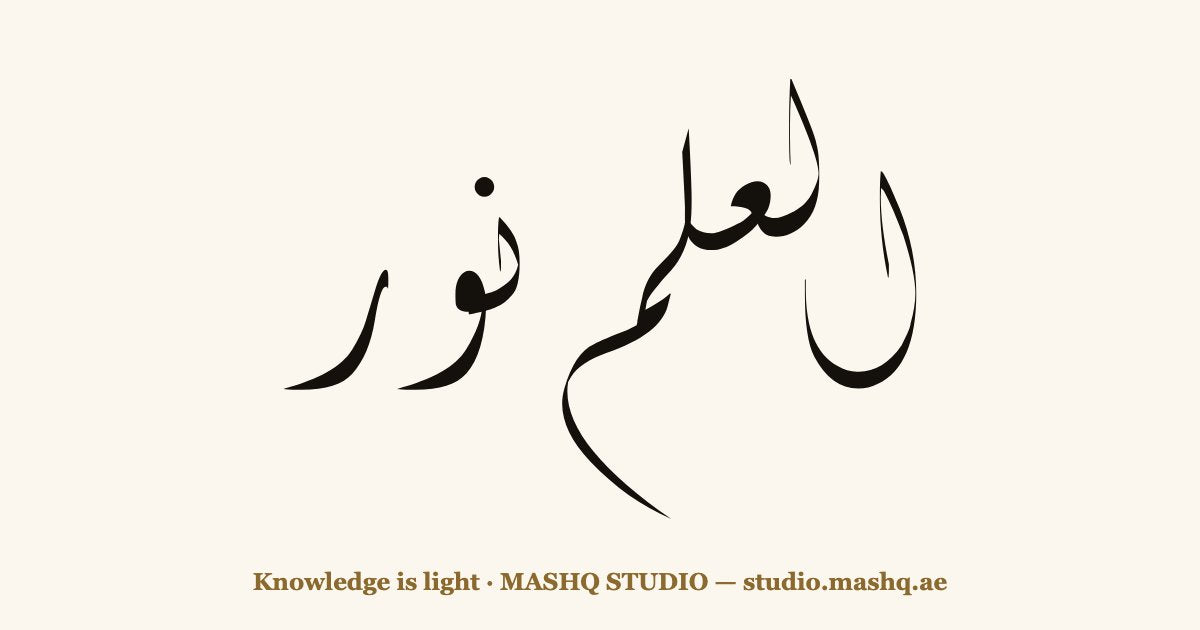
Diwani was the script of the Ottoman chancery, and it is what most people picture when they say "Arabic calligraphy": letters that knot and climb, a line that becomes an ornament before it becomes a sentence. It is the script we write most Arabic proverbs in — «الصبر مفتاح الفرج», «العلم نور» — and the one most people choose for a name. One honest note: Diwani is genuinely hard to read at a glance. That is part of its charm, and worth knowing before you choose it for a phrase a guest must read. Diwani wall art. A piece in Diwani: «الله لا إله إلا هو الحي القيوم», a calligraphy paint.
Kufi — the geometric one
Kufi is the oldest of the great scripts: the angular hand of the first Qurans and of the carved inscriptions on Fatimid Cairo. Straight lines, measured curves, letters that read as architecture. Designers reach for it when a wall wants geometry rather than flourish, and it makes a monogram out of a single name. Rasha Kasim's signed originals are Fatimid Kufi; see the Kufi collection. A piece in Kufi: «سلام», a serving tray.
Ruq’ah — the everyday hand
Ruq’ah is the quick, clipped script of notes, shop signs and letters across the Arab world. Warm where Thuluth is grand, and the right voice for a joke or a morning greeting — nobody says «لا تكلّمني قبل القهوة» in Thuluth. This is the script of our coffee trays and mugs. A piece in Ruq’ah: «قهوة عربية وقلب طيّب», a mug.
Nastaliq — the Persian hanging script
Nastaliq leans down and to the left as if written on a slope; a line of it looks like it is being spoken softly. It is the script of Hafez and Saadi, and the only one that makes Persian poetry look like itself. Our Nastaliq pieces carry Rumi, Saadi, Ferdowsi and Hafez, each with the poem's meaning in English and Arabic on the page. A piece in Nastaliq: Rumi's «بشنو از نی چون حکایت میکند», a calligraphy paint.
So which one?
- A name, framed as a gift: Diwani first, Thuluth for a grander wall, Nastaliq for a Persian name. Try all three in seconds on the name piece page.
- A phrase everyone must read (a tray, a tissue box, a sign): Naskh or Ruq’ah.
- A Quranic verse: Thuluth on a wall, Naskh on an object.
- A modern, geometric room: Kufi.
- Persian poetry: Nastaliq, always.
Still unsure? Write the words in Mashq Studio — free, no account — and see them in every script before you order. We confirm spelling with you on WhatsApp before anything is printed.
Related reading: Diwani vs Thuluth: The Difference, and Which to Choose · 43 Arabic Phrases for Wall Art, With Their Meanings.